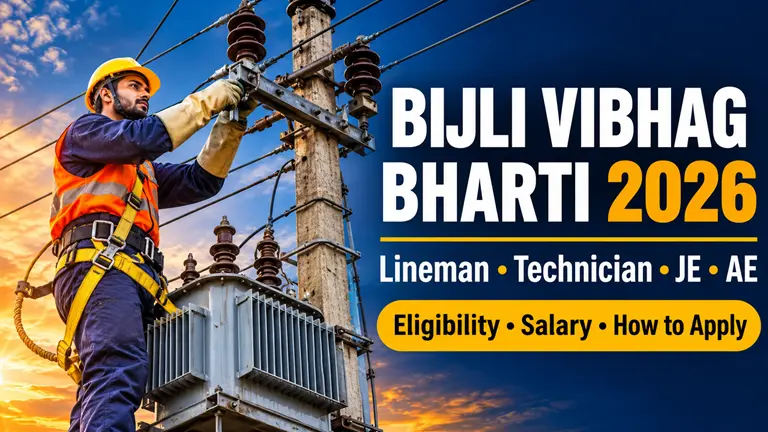

Every light, fan and water pump in your village or city depends on people working in the bijli vibhag. Linemen climb poles in the rain to restore supply. Technicians keep transformers and substations running. Junior Engineers plan new connections and check meters. Behind them are clerks, data entry operators and accountants who keep bills and records in order.
In most states, the old State Electricity Board has been split into separate companies. One company generates power, one transmits it on high-voltage lines, and one or more distribute it to homes and shops. For example, Rajasthan has RVUN for generation, RVPN for transmission, and JVVN, AVVN and JdVVN for distribution. Each of these companies recruits its own staff, which is why Bijli Vibhag Bharti news keeps coming from different states through the year.
Bijli Vibhag vacancies open right now
Four electricity-sector recruitments are accepting applications as of 13 November 2026. Dates are as published; always confirm on the official website before applying.
Chhattisgarh: the biggest open drive this month
The Chhattisgarh notice covers 195 Class II and 1,306 Class III and IV posts. The biggest groups are 450 Data Entry Operators in CSPDCL, 300 Plant Attendant Gr. III posts in CSPGCL, and 163 JE (T&D) posts in the distribution and transmission companies.
Recently closed or on hold
| Recruitment | Status |
|---|---|
| PSPCL Assistant Lineman, CRA 317/26 & 318/26 (6,289 posts) | Applications closed in July 2026; reported cancelled for administrative reasons, with a fresh notice possible. Check pspcl.in. |
| Rajasthan power companies (RVUN, RVPN, JVVN, AVVN, JdVVN): 2,005 JE-I, Junior Accountant, Junior Assistant | Applications closed on 25 Aug 2026; exam date awaited. |
| RRVUNL Technician-III, Operator-III, Plant Attendant-III (2,163 posts) | Final result declared on 22 Jun 2026. |
Expected soon
JBVNL (Jharkhand): AE/JE recruitment has been reported as expected around November 2026. No official notice confirmed yet.
What does a Bijli Vibhag job involve?
The work depends on which company you join. In a generation company (thermal, hydro or solar plants), you run and maintain boilers, turbines, generators and control panels in shifts. In a transmission company, you look after high-voltage lines and grid substations, usually 66 kV or 132 kV and above. In a distribution company (discom), you deal directly with the public: 33 kV and 11 kV lines, low-tension lines, distribution transformers, new connections, meters and complaints.
Most vacancies come from discoms, because they cover every village and town. That is also where you will find the largest number of Lineman and Technician posts.
Main posts explained
A typical day for a Lineman or Technician
- Report at the sub-division or substation office and take the day’s work list from the JE.
- Collect tools and safety gear: helmet, insulated gloves, safety belt, earthing rod.
- Take a written shutdown (permit) before touching any line, then earth it on both sides.
- Attend fault complaints: a burnt fuse, a broken jumper, a tripped transformer.
- Help with new connections and meter installation or replacement.
- Fill in the logbook and report pending work before handing over.
In summer and the monsoon, fault calls rise sharply. Emergency duty at night and on holidays is part of the job.
Eligibility checklist
Every board sets its own rules, but most electricity posts follow the same pattern. Use this checklist to see where you fit.
- ✓ You have ITI in Electrician, Wireman or Lineman trade, or a diploma or degree in Electrical Engineering
- ✓ You are physically fit and comfortable working at height and outdoors
- ✓ You can do night duty and emergency calls during storms and festivals
- ✓ You follow safety rules strictly, every single time
- ✓ You are ready to be posted in rural areas, not only in your home town
- ✗ You are afraid of heights or climbing poles
- ✗ You want only office work (then choose DEO, clerk or accounts posts instead)
- ✗ You take shortcuts with shutdowns and earthing
- ✗ You expect a contract (samvida) job to become permanent without an exam
Qualification and age by post
| Post | Usual qualification | Age (recent examples) |
|---|---|---|
| Assistant / Junior Lineman | 10th + ITI (Electrician or Wireman), or National Apprenticeship Certificate in Lineman trade | 18–37 years (PSPCL 2026) |
| Technician / Plant Attendant | 10th (second division in CG) + 2-year ITI in the relevant trade | 18–40 years; up to 45 for reserved categories (CSPC 2026, CG domicile) |
| Junior Engineer | 3-year diploma (Electrical, Civil, etc.); some boards ask for B.E./B.Tech (Rajasthan JE-I) | 18/21–40 years (CSPC 2026); 18–40 years (Rajasthan 2026) |
| Assistant Engineer | 4-year B.E./B.Tech or AMIE | Up to 40 years for CG domicile, 30 for others (CSPC Class II) |
| PSU Engineer Trainee | B.E./B.Tech with 60% + valid GATE score | Up to 28 years for UR (POWERGRID 2026) |
| ITI Apprentice | 10th + ITI in the trade (BBMB asks for 40% in 10th) | As per the Apprentices Act and the notice |
| Data Entry Operator / Clerk | 12th or graduation with a computer qualification; typing test | Usually 18–40 years |
Bijli Vibhag salary: what recent notices offer
Salary depends on the state, the company and the post. The bars below show the starting basic pay printed in recent 2026 notices. Your in-hand salary will be higher, because Dearness Allowance (DA), House Rent Allowance (HRA) and other allowances are added on top of basic pay.
Skills that help you earn and grow faster
- Trade certificates: ITI plus a National Apprenticeship Certificate (NAC) opens Lineman posts that ask for it, like PSPCL’s CRA 317/26.
- Safety discipline: a clean safety record matters for promotions and for being trusted with substation duty.
- Computer skills: billing software, MS Excel and online complaint systems are now used in every sub-division.
- Higher qualification: a diploma lets a Technician compete for JE posts, and a degree opens AE and PSU roles.
- Exam readiness: reasoning, arithmetic and general knowledge decide the cut-off as much as the trade paper.
Selection process and exam pattern
Most state electricity recruitments now follow the same path:
Example 1: Chhattisgarh Power Companies 2026 (JE, Attendant, DEO and others)
| Part | Questions | Marks |
|---|---|---|
| Professional subject (your trade or branch) | 80 | 80 |
| General knowledge, English, Hindi, reasoning, quantitative ability | 20 | 20 |
| Total | 100 | 100 |
Time: 2 hours. Negative marking: 0.25 mark per wrong answer. Minimum qualifying marks: 40% for UR/OBC and 30% for SC/ST. AE posts add an interview; DEO posts add Hindi and English typing tests.
Example 2: PSPCL Assistant Lineman 2026 (as notified)
| Part | Questions | Marks | Counts in merit? |
|---|---|---|---|
| Part I: Punjabi language | 50 | 50 | No (must score 50%) |
| Part II: Electrician/Wireman trade | 50 | 50 | Yes |
| Part II: Punjabi grammar | 20 | 20 | Yes |
| Part II: General knowledge | 10 | 10 | Yes |
| Part II: Reasoning | 10 | 10 | Yes |
| Part II: Arithmetic | 10 | 10 | Yes |
Time: 3 hours for both parts. No negative marking. This shows a common point: many states test the local language, so read the language rules in your state’s notice early.
Example 3: Central PSU Engineer Trainee (POWERGRID 2026)
There is no separate written exam. Selection uses your GATE 2026 score (85% weight), a group discussion (3%) and a personal interview (12%). You must score at least 40% in the interview (30% for reserved categories).
Syllabus: what to study for each post
The official syllabus is printed in each notice, and it can differ by state. The topics below appear again and again in electricity board papers, so they are a safe base to start with.
- Basic electricity: Ohm’s law, Kirchhoff’s laws, series and parallel circuits, power and energy
- Conductors, insulators, cables and their ratings
- AC fundamentals: single and three phase, star-delta, power factor
- Magnetism and electromagnetic induction
- Cells and batteries
- Transformers, DC and AC motors, generators, starters
- Instruments: multimeter, megger, tong tester, energy meter, CT and PT
- Wiring and earthing, earth resistance
- Overhead lines: poles, cross-arms, insulators, stay wires, jumpers, sag
- Distribution transformers and substations
- Protection: fuses, MCB, ELCB/RCCB, relays, breakers, lightning arresters
- Safety: shutdown and permit system, safety gear, rescue from shock, CPR
- Electrical circuits and network theorems
- Machines: transformers, induction motors, synchronous and DC machines
- Power systems: generation, transmission, distribution, protection and switchgear
- Measurements and instruments
- Basic electronics and power electronics
- Utilisation: illumination, heating, traction and drives
- Estimation and costing
- CEA safety regulations and Indian Electricity Rules
- GK: current affairs, your state’s geography and history, your state’s power sector
- Reasoning: series, coding-decoding, blood relations, directions, analogies
- Arithmetic: percentage, ratio, average, profit and loss, time and work, interest
- Language: Hindi and English grammar, plus the state language where asked
- Computer fundamentals, MS Word, Excel, PowerPoint, internet and email
- Typing speed practice in Hindi and English (check the speed in the notice)
- The general section topics
Three ways to work in the bijli vibhag
Not everyone you see working on electricity lines is a permanent employee. There are three different routes, and it helps to know which one you are applying for.
- Hired by the power company through an official notice
- Online application, CBT, document verification
- Pay matrix with DA, HRA and allowances
- High job security after probation
- Best for a long-term career
- Hired by a private agency holding a discom contract
- Agency interview or walk-in
- Fixed monthly wage, usually close to the state minimum wage
- Depends on contract renewal
- Quick income and field experience
- Trained by the power company under the Apprentices Act
- Merit list from 10th and ITI marks
- Fixed stipend (₹9,600 at MPPGCL 2026)
- Ends after training, usually one year
- Best for freshers who want certified experience
Where real hiring is announced
- The official website of your state’s power companies, for example cspc.co.in, pspcl.in, uppcl.org and energy.rajasthan.gov.in
- apprenticeshipindia.gov.in for apprentice seats
- Career pages of central power PSUs such as POWERGRID, NTPC and NHPC
- Employment News and your state’s official employment portal or Rozgar Mela
- Trusted job news websites that link to the original notice PDF
Your rights as a contract worker
If you join through an agency, ask for these from day one:
- A written appointment letter with wage, working hours and contract period
- Wages at least equal to the state minimum wage for your skill category, paid on time
- EPF and ESI contributions, with a UAN you can check online
- Free safety gear: helmet, insulated gloves, safety belt and shoes
- A salary slip every month
Keep copies of all papers. If wages or PF are not paid, complain in writing to the agency first, then to the discom’s executive engineer and the local labour office.
Growth path in the power sector
A Lineman or apprentice job can be the first step in a long career:
How to apply for Bijli Vibhag Bharti
- Step 1Find the official notice
Open the power company’s own website and download the notification PDF. Do not rely on a forwarded image. - Step 2Read the eligibility carefully
Check the trade or branch, the age cut-off date, domicile rules, and conditions such as a service bond or security deposit. - Step 3Register
Create an account with your own mobile number and email ID. Note down your registration number and password. - Step 4Fill in the form
Enter your name and date of birth exactly as in your 10th certificate. Choose the right post code and category. - Step 5Upload photo and signature
Use the size and format given in the notice. - Step 6Pay the fee online
Save the payment receipt. Some boards keep a separate fee deadline. - Step 7Download the final form
Keep a printout. Admit cards and results come on the same website.
Application fee examples (2026)
| Recruitment | General | Reserved categories |
|---|---|---|
| CSPC Chhattisgarh: AE, JE and officer posts | ₹800 (UR), ₹700 (OBC) | ₹600 (SC/ST) |
| CSPC Chhattisgarh: DEO, Attendant and other posts | ₹400 (UR), ₹300 (OBC) | ₹200 (SC/ST) |
| PSPCL Assistant Lineman | ₹1,416 | ₹885 (SC/PwD) |
| POWERGRID Engineer Trainee | ₹500 (General/OBC/EWS) | Nil (SC/ST/PwBD/Ex-Servicemen) |
| Apprenticeship seats | Usually no fee | Usually no fee |
Documents checklist
Preparation tips that actually work
- Start with your trade theory. For ITI posts, the trade paper carries the biggest share of marks (80 of 100 in Chhattisgarh). Revise your ITI Electrician or Wireman theory book chapter by chapter.
- Solve previous papers of the same board. Each board repeats its style, and old papers show which topics come most often.
- Make a daily routine. Two hours of trade or branch subject, one hour of reasoning and arithmetic, and 30 minutes of current affairs is a good base.
- Take timed mock tests every week. Practise finishing 100 questions in 2 hours.
- Respect negative marking. Where wrong answers cost 0.25 marks, skip pure guesses.
- Do not ignore the language part. Some states, like Punjab, make a local language paper compulsory.
- For DEO and clerk posts, practise typing daily in both Hindi and English.
Interview tips (AE and PSU posts)
- Revise your final-year subjects: power systems, machines and protection come up most.
- Know the basics of the company: what it generates, transmits or distributes, and in which areas.
- Be ready to explain your final-year project in simple words.
- Read recent power-sector news: new capacity, smart meters, renewable energy targets.
- Dress formally and carry all original documents in a file.
What the real work environment is like
Field jobs in the bijli vibhag are physical and outdoor. You will work in summer heat, heavy rain and winter fog, often when everyone else is indoors. Fault calls rise during storms, and supply has to be restored even at night.
You will also face angry consumers during power cuts, so patience and clear talk help a lot. Postings are often in rural sub-divisions at first.
On the positive side, the job is stable, respected in the community, and every day you can see the difference your work makes.
Scams and common mistakes to avoid
Bijli Vibhag Bharti attracts lakhs of applicants, so it is a favourite target for fraud. Be careful about these:

